Trauma doesn’t disappear when the moment ends. It settles into the body—into the nervous system, the breath, the muscles that clench without permission. It lingers long after the world has moved on, long after people think you should be “better.” Trauma isn’t just a memory; it’s a physical imprint.
My own story with trauma stretches back years. I lost my mom in 2011, a loss that split my world in two. But even then, looking back, I realize what a blessing it was that I had found CrossFit in 2009. I threw myself into it without knowing that this community and this kind of movement would become the thing that held me together. CrossFit didn’t just make me physically stronger; it saved me emotionally at a time when I didn’t know how to save myself. It gave me a place to put the pain when I didn’t have words for it.
Then came more loss—a close friend in 2012, my dad in 2013—and then the long, heartbreaking journey of my husband’s leukemia. Diagnosed in 2019. Treated in 2020. A bone marrow transplant. Hope. Fear. The return of cancer in August 2023. He was gone a month later. The hurt runs deep and the pain I carry for my kids is immeasurable and something I can’t fix, something that will always live in me.
And yet, through all of it, movement kept me breathing.
Trauma Lives in the Body. Movement Helps It Move Through.
Trauma is pain you didn’t choose.
Training is discomfort you do choose.
There’s something grounding in that—something healing. When the world is out of your control, training gives you a space where your decisions matter again. You decide when to push, when to rest, when to keep going.
CrossFit built my strength.
Olympic weightlifting taught me patience, precision, and how to trust my body again—lesson by lesson, lift by lift.
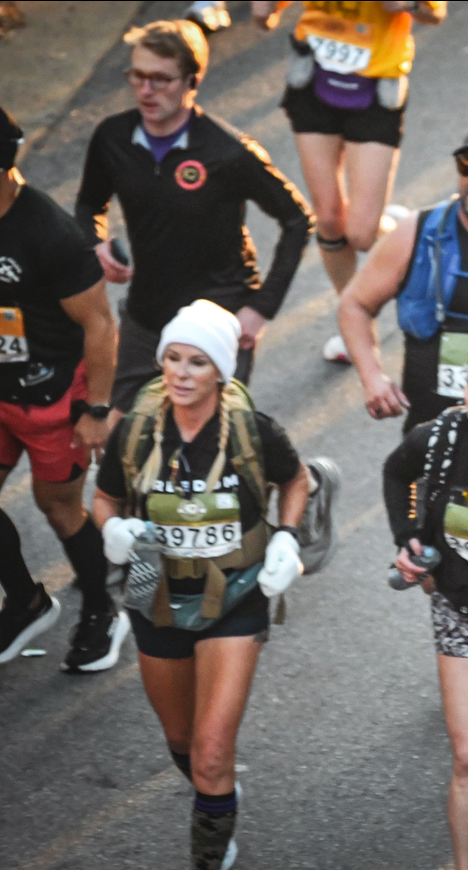
Spartan Racing built grit and GORUCK events introduced me to a different kind of endurance: the slow, steady kind that teaches you how to carry weight—literally and emotionally—for hours.
And now, running has become my newest teacher.
After years of strength work, lifting, long Spartans and GORUCK events, running felt different — quieter, more intimate. There’s nothing to hide behind when you run. No barbell to grip, no team to lean on, no weight on your back besides whatever you’re carrying inside. Running forces you into conversation with your own breath, your own thoughts, your own pain. It’s become another kind of endurance for me — steady, rhythmic, honest. Each mile gives me space to process what my heart still struggles to hold. In many ways, running is where the healing settles in. It’s where I start to feel the pain turn into something I can move with instead of something that keeps me stuck.
Hypervigilance, Training, and the Art of Reading Yourself
After trauma, your nervous system is always scanning for danger. You learn to read every environment, every shift, every feeling in your body.
Ironically, training uses the same skill set.
You learn to read yourself—your effort, your breath, your limits. You become fluent in your own signals. And in that awareness, you find grounding you didn’t know you needed.
Doing Hard Things Alone Doesn’t Scare You
One of trauma’s cruelest lessons is that you can’t always rely on others. You learn to hold yourself up because you’ve had to. So when training asks you to face hard sessions alone—early morning runs, heavy lifts, grueling workouts—it doesn’t intimidate you—it strengthens you.
You’ve survived worse.
Routine Becomes Safety
After loss, your nervous system craves routine. Structure becomes a lifeline. Training plans, cycles, goals—they become anchors. They create predictability when everything else feels uncertain.
Movement Turns Pain Into Power
Grief doesn’t go away. My heart still breaks for my kids, for what I can’t fix. That pain still lives in my body.
But movement transforms it.
It softens it.
It gives it direction.
Your body remembers trauma—but it also remembers every finish line, every PR, every mile, every moment you kept going when stopping felt easier.
It remembers that you didn’t quit.
Endurance Isn’t Just a Sport—It’s a Way of Living After Loss
Endurance isn’t just distance.
It’s staying present through discomfort.
It’s continuing when you’re tired.
It’s trusting that forward—even slow—is still forward.
Whether it’s CrossFit, weightlifting, rucking or running, the label doesn’t matter. What matters is that these practices build the capacity to sit with hard things. They teach you that you can endure.
And after everything you’ve walked through, that truth is worth holding onto.
Movement won’t erase trauma.
But it can help you live with it- and sometimes, it can help you rise above it. Movement has saved me time and time again and for that I am so grateful. #dohardthings